Caring for people with chronic disease accounts for more than 75% of health care spending. As chronic disease progresses, the amount of care delivered and the costs associated with this care increase dramatically. Patients with chronic illness in their last two years of life account for about 32% of total Medicare spending, with much of it going toward physician and hospital fees associated with repeated hospitalizations.
Medicare spending varies more than threefold among hospital referral regions. Spending also varies from state to state, and from one hospital to another, even among hospitals within the same region. Most of this variation is not due to differences in the price of care in different parts of the country, but rather to differences in the volume, or the amount of inpatient care delivered per patient.
Most hospitalizations are for conditions that have high or very high patterns of variation in their discharge rates. Medical discharges are more variable than surgical discharges. For medical conditions, the majority of variation is associated with hospital capacity (as measured by the per capita supply of hospital beds).
For patients with medical conditions, geography matters; patients with medical conditions receive very different care depending upon where they live. Why does care vary so much? The most obvious explanation might seem to be regional differences in how sick patients are. But the prevalence and severity of illness accounts for remarkably little of the variation in care.
Most patients defer to their physicians when it comes to deciding what care they receive. When it comes to elective surgery, physician opinion can vary widely as to when the treatment is necessary, and which patients are appropriate. Consequently, the frequency of discretionary surgery such as knee or hip replacement or back surgery, also varies remarkably from one region to another.
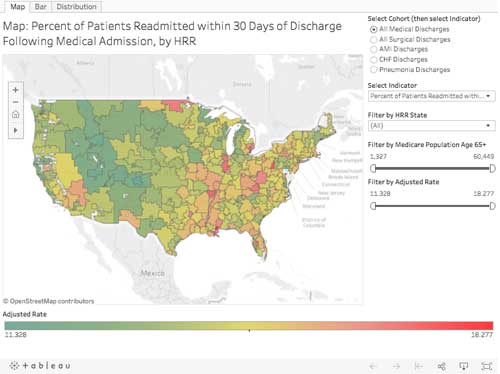
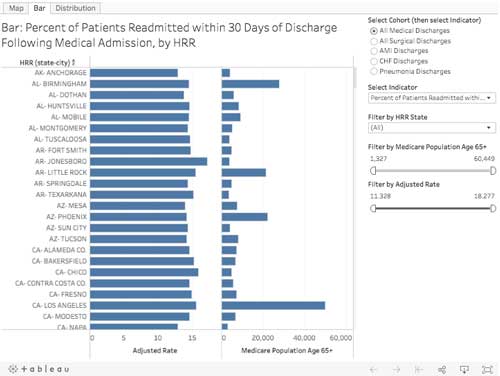
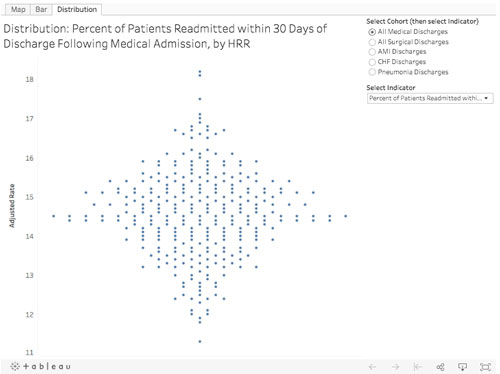
Improving care coordination after discharge from the hospital is important to patients, to hospitals and to Medicare. Without high-quality care coordination, patients can bounce from home to the emergency room and back into the hospital, sometimes repeatedly. Better care coordination promises to reduce readmission rates and improve patients' lives while reducing costs.
Effective care consists of evidence-based interventions for which the benefits so far exceed the harms that all patients in need should receive the service. Life-saving drugs following heart attack are examples. Variations in the use of such treatments among eligible patients
reflect a failure to deliver needed care, or underuse.
Regional variation in hospital and physician capacity reveals the irrational distribution of valuable and expensive health care resources. Capacity strongly influences both the quantity and per capita cost of care provided to patients. Better planning of future growth in capacity can help build a more effective and affordable health care system.
Modern technology has vastly extended the ability to intervene in the lives of patients, most dramatically so when life itself is at stake. But the capability to intervene is not uniformly deployed, and health care providers do not share a uniform propensity to hospitalize dying patients or to use technology at the end of life. The American experience of death varies remarkably from one community to another.
The Primary Care Service Area (PCSA) Project offers data and analytic tools to identify primary care clinician supply and needs in communities across the United States, with areas that reflect patients’ travel to primary care. PCSA data can help identify areas with low supply of primary care and safety net providers, and populations with relatively high health risk. The PCSA project also provides information about primary care utilization by the elderly.